Forum
WARNING:This product contains nicotine. Nicotine is an addictive chemical.
Launch Time: 2016-12-20 Views: 2180 Rely: 0 Started by:

Some of our clients have misunderstandings about BDC, BVC and many other professional glossary and today, I am going to bring out some detailed explanation and description for you to know more about this glossary..Besides, we will also compare different materials used as coils for you. If aren’t already familiar with coils, you’ll find the following definitions helpful when reading this article!
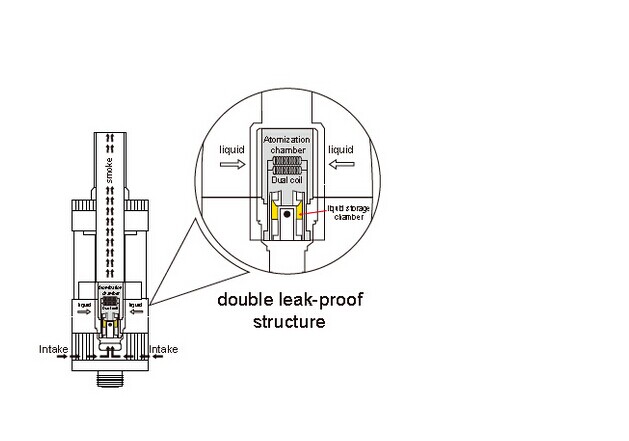
In the following, I am going to give a classification on commonly seen materials used in coils.
Kanthal
Function: Used in wattage mode.
Pros:
Can handle very high temperatures
Easy to work with
Readily available in many gauges to suit different build needs
Very stable resistance
Usable with every device
Cons:
No temp mode functionality
Can cause a drop in flavor clarity after prolonged use, but generally pretty good.
Can taste metallic when first installed
Ni200 (nickel, 99.6%)
Function:Temperature control (or as I prefer, temperature limiting)
Pros:
The standard wire for temp control mods
Resistance changes during heating are accurately predictable (this is how temp control coils work: they change resistance as they heat, the device picks up on this, and knows what temp they are at due to the change)
Due to the the accuracy of the readings it gives a very consistent vape, in both performance and flavor
At high temperatures, e-liquids base chemical elements can transform, leading to undesired formulas. This can help prevent that happening
Cons:
When building, tricky to work with due to the flexibility of the wire
If not built with just the right amount of wicking, can lose consistency
Only usable in temp mode, NOT to be used in wattage
More prone to gunk build up
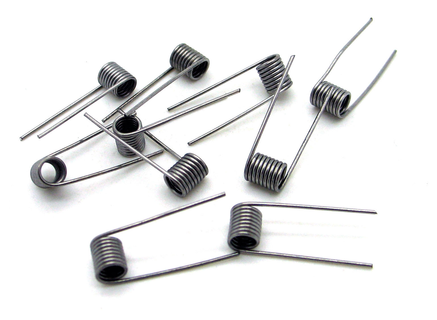
Stainless steel
Function:Wattage and temp control
Pros:
Very versatile working for both Wattage and TC Modes
Easier to work with than Ni200 for temp coils, as it holds shape better
Can last longer than a kanthal coil
Heats very quickly, delivering a more instant hit
Shorter ‘breaking in’ period than kanthal, less metallic taste
Subjective perhaps, and may be different depending on liquid used, but many people say it has a cleaner, purer taste than kanthal
Cons:
Resistance fluctuates with heat, so less consistent in wattage/power mode
More likely to suffer from ‘hot spots’ when building a micro coil (where each loop touches, hot spots arc the current across wraps rather than flowing through each one)
Better performance when you can control wattage within a temp setting.
Vertical coil
In a vertical coil such as the Aspire Cleito the coil stands upright, surrounded by a cotton wick. This allows for a direct airflow. Couple this with a large core diameter, allowing more air to pass through quicker, and you start to see why they have become so popular! This direct airflow allows the coil to have a consistent heat along its length, giving a more even evaporation of the e liquid. This in turn gives you a more consistent vape and flavour, and also reduces the risk of dry spots which can burn the wick.
But do vertical coils produce more flavour?
Technically speaking, the fact:
means it should produces slightly less flavour than a comparable horizontal coil. However this is a controversial area and you’ll find many different opinions! Perceptions are key here. The vast majority of tanks readily available these days are sub ohm with vertical coils. Only a few have horizontal coils, which makes the comparison difficult to make. However, tank users often say vertical tastes better, while RDA users prefer horizontal coils.
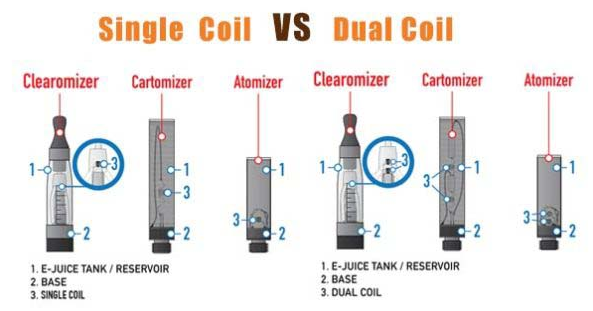
Design: Horizontal Coil
Due to the increased popularity of vertical coils, the horizontal design has become much less prevalent this past year. Vertical coils can have either inner or outer wicking. However, you won’t find a horizontal stock coil with outer wicking, and it’s rare for DIY coil builders to use these too. Due to the way that airflow passes up around these coils, if they’re not centered properly, there may be some performance variation between like for like coils. However, this is unlikely to be as noticeable when compared with DIY coils in an RDA placed incorrectly.
Spitback in Horizontal and Vertical Coils
Another contentious matter is spit back, when the coil occasionally spits hot liquid into your mouth. Logic would say, due to the direct airflow, vertical coils would be the worst culprit. However, horizontal coils can also sometimes spitback as evaporation takes place on the outer edge of horizontal coils. You can also adjust the power up or down, as different atomisers tend to spit more at varying voltages. Of course this isn’t always ideal, especially for cloud chasers! If their particular model spits more at higher power, they don’t want to turn it down!