Forum
WARNING:This product contains nicotine. Nicotine is an addictive chemical.
Launch Time: 2017-03-08 Views: 2365 Rely: 0 Started by:
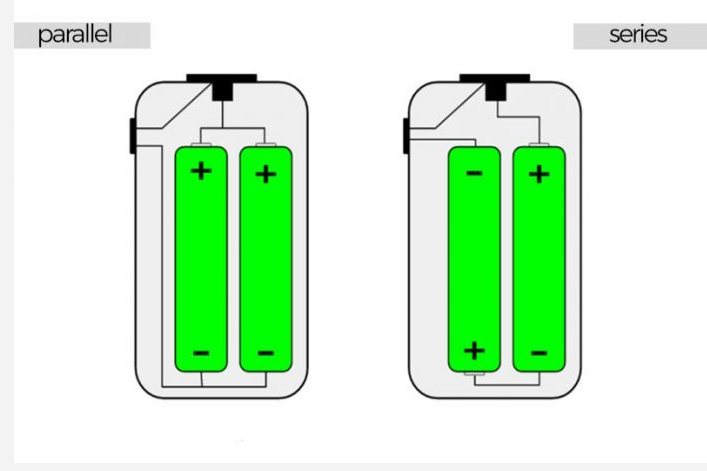
If you want to get a dual-battery mechanical mod but aren’t clear on the difference between a parallel and series battery configuration, this post is for you. You do all the right things: you understand Ohm’s Law, battery limitations, safety and you confidently head to your local shop to look at some shiny new mods… And that’s when things suddenly get cloudy as the salesperson shows you some mods, explaining that some are “series” and others are “parallel”. Great. You depart with your head spinning as you try to make sense of what you have found, and being the responsible vaper you are, you immediately head home to do more research.What is the difference between a parallel and series mod?
In the simplest of terms, the answer is voltage. There are other considerations critical to user safety and we’ll get to that later, but the key difference is voltage. Note: In the following examples, let’s assume that we are using two identical 18650 batteries with 3.7 volts, max continuous discharge rating (CDR) of 20 amps, and 2000 mAh capacity each. A well-known example of a dual-cell parallel box mod is the MCV Cherry Bomber. In this configuration, the batteries are working side-by-side with the positive terminals wired together and the negative terminals wired together. Remember, “wired” in this context merely means electrically connected, and you will generally not find any actual wires inside the mod.
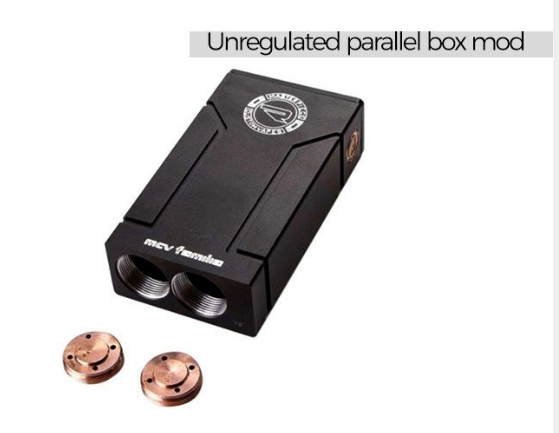
In parallel, the resulting voltage is the equivalent to one of the batteries — in our example 3.7V. In a parallel circuit, current is split evenly between the two cells, effectively doubling the maximum CDR available to the coil and also doubling your battery capacity (run time) compared to a single battery. In our example, the max current available would be 40 amps, and the capacity 4000 mAh.
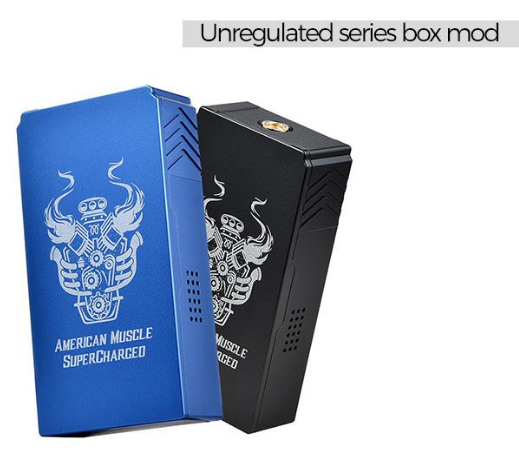
Note: In the following examples, let’s assume that we are using two identical 18650 batteries with 3.7 volts, max continuous discharge rating (CDR) of 20 amps, and 2000 mAh capacity each. Probably the best-known example of a dual-cell series box is the Wismec Noisy Cricket. A series battery configuration is just as described: the batteries are placed (or connected) end-to-end, one after another. The most common example of series battery usage outside of vaping would be a dual battery flashlight.
In a series configuration, the resulting voltage is additive — in our example 3.7V + 3.7V = 7.4V. The current in the circuit, however, is limited to the maximum CDR of a single battery or 20 amps since the same current is pulled through both batteries. Lastly, the life of our series configuration would also be the equivalent of a single battery or 2000 mAh.
The key thing to remember is that the same load (build) is going to behave very differently on each of these mods. For example: On a parallel mod at 3.7 volts, a 0.15-ohm load will pull 24.6 amps from your batteries and result in around 91.3 watts. The same load on a series box at 7.4 volts would pull over 49.3 amps and give you 365 watts — which of course is way outside of the safe limits of the batteries. If you up the resistance of your build to 0.5-ohms, and use heavier wire — like clapton coils — the resulting load will pull 7.4 amps and deliver a mere 27.4 watts to your coils on a parallel mod. The coils will heat slowly, and the vape will be cool. On the series mod, the claptons will pull 14.8 amps and give you just under 110 watts, and the coils will ramp very quickly compared to the parallel box, giving you a much warmer and denser vape.
TAGS:Mechanical Mods, ECIGS MODS