Forum
WARNING:This product contains nicotine. Nicotine is an addictive chemical.
Launch Time: 2017-03-27 Views: 3041 Rely: 0 Started by:

If you are comfortable with your knowledge of battery safety, the next consideration is using some sort of calculator to make sure your coil builds are within that safe limits of your battery, and further, to allow you to tweak your coils to get the vaping experience you desire. There are tons of Ohm’s Law calculators, and sites like Steam Engine that will do the heavy lifting for you. If you are happy with those, and wish to remain blissfully ignorant about what is actually behind the calculations, good for you. As long as you know how to apply the results and use an ohm meter, you will live a long, happy, and safe vaping life.
There’s nothing mystical or magical about Ohm’s Law. It’s a few formulas, usually depicted inside of a triangle, and anyone can easily learn and use the formulas with any regular calculator. No special “Ohm’s Law Calculator”, no Steam Engine required. In fact, I’m pretty sure that I learned Ohm’s Law in the very first electronics class I took after leaving high school – probably in the first day or two. It’s really that simple. The goal here is to show you the formulas behind Ohm’s Law and hopefully give you an understanding of the relationships between the different elements in a basic electronic circuit as related to vaping.
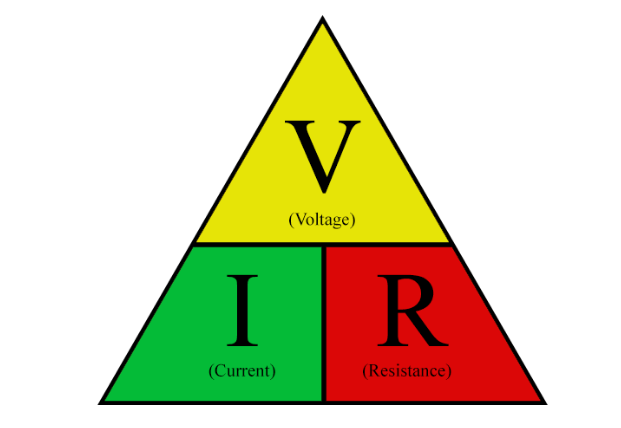
Inside the triangle you can see the three main elements in any electrical circuit, represented b y the letters V, I, and R. I would vocalize the triangle a s “V over I times R” with “times” being multiplication. The hardest part of this will be remembering what the letters represent, and that’s easy:
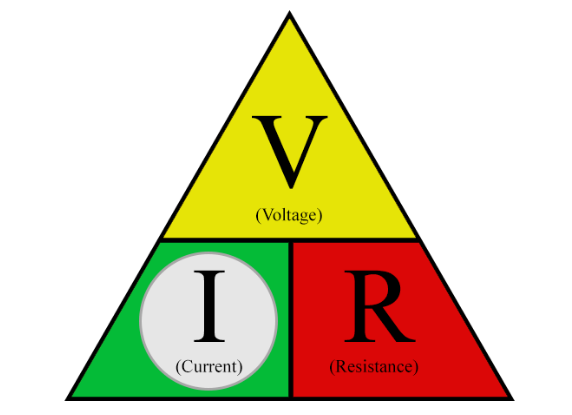
So, how do we use the Ohm’s Law triangle? Again, simple – the triangle visually depicts the relationship between voltage, current, and resistance. In the following examples we’ll explore how to use the triangle and formulas to help you build coils targeting the current and wattage you desire. If you want to determine the current draw through a resistance (your coil) the formula is:
I = V ÷ R (or I = V/R)
How did we arrive at that? Look at the triangle and you will see that to solve for current (I) you must divide voltage (V) by resistance (R). Let’s put the formula to work in a real life example. If you are using a mechanical mod, with a freshly charged battery you theoretically have 4.2V available to power your coil. If your coil is 0.5Ω, you now have everything you need to determine current, in amps:
I = 4.2V ÷ 0.5Ω (or 4.2/0.5)
I = 8.4A
As you can see, with your 0.5Ω coil and a freshly charged battery at 4.2V, the resulting current draw will be 8.4 amps. If your battery has a 10A limit, you are well below the cap. Also note that as the battery depletes, the current will also tail off. For example when the battery reaches 3.7V with the same load, current will drop to 7.4A. Go ahead, do the math – I’ll wait. (Hint: replace the 4.2V in the above example with 3.7V). The next thing you will probably want to know is the power generated at the coil, or wattage. It’s not shown in the triangle, but the formula is simple. Just multiply the current in your circuit by the voltage applied:
P = V x I
In our original example, the formula would look like this:
P = 4.2V x 8.4A
P = 35.3W
So that 0.5Ω coil with a fully charged battery at 4.2V will pull 8.4A and deliver 35.3 watts. You can see that as the resistance of your coil increases, current will drop and wattage will drop. The second Ohm’s Law formula that can be of use to us is calculating resistance. Let’s say that you have a battery with a 10A current limit and you want to determine the lowest coil resistance that you can safely run without exceeding the CDR of the battery.Do you want to know more about ecigs information, come to the ecig forum!
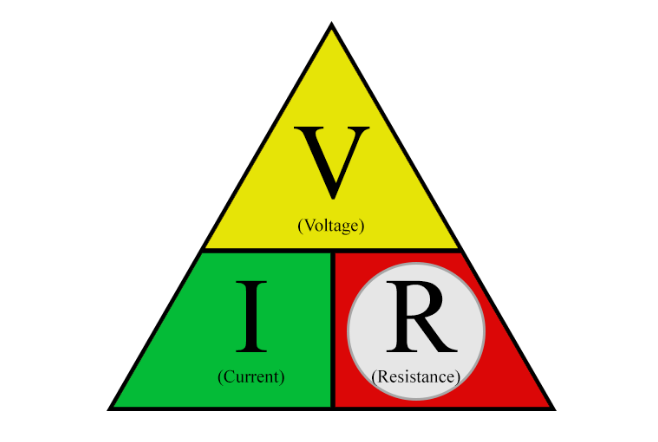
To calculate, you would use the following formula:
R = V ÷ I
Since you know that the battery CDR is 10A, you might want to target 9A in your calculation, to give yourself 1A of headroom. You also know that your max voltage will be 4.2V on a single battery mod. So the calculation goes like this:
R = 4.2V ÷ 9A
R = 0.47Ω
The result tells you that your safe lower limit with the 10A battery is 0.47Ω – anything lower and you risk exceeding the current limit of the battery, and a ka-boom. Of course if you have a 25A battery, your low resistance drops to 0.17Ω (substitute 25A for 9A in the equation above).
R = 4.2V ÷ 25A R = 0.17Ω
R = 0.17Ω
Finally, and probably not as useful to us, using the triangle you can solve for voltage in a circuit, as long as you know the values of the other two variables. To solve for voltage when current and resistance is known, the formula looks like this:
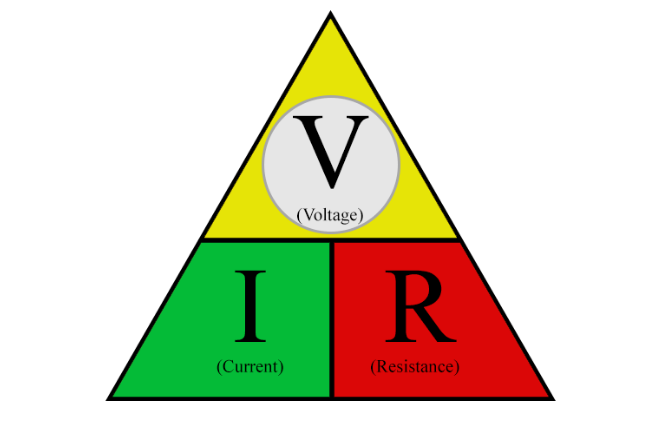
V = I x R
Really, the most useful formulas to me as a vaper, are the three that calculate current (I = V ÷ R) and power (P = V x I) and resistance (R = V ÷ I). These will allow you to figure out the current your coil will draw and the wattage that will result. As you increase resistance, current and power will drop off. If you decrease resistance, current and power will increase. The resistance formula allows you to calculate a safe low resistance based on the CDR of your battery.